
Welcome to NN!

Naya' s YouTube Channel

Subscribe to my YouTube to make sure you don't miss out on my latest videos!

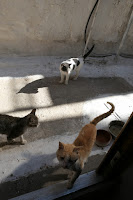
Feeding the neighborhood's cats

Stray cats are a very common sight in the place where i live.

I take care of feeding them everyday and having a bowl full of water for them, much more so in the summer months when it can be very hot.
A pair (or two or three...) of eyes look at me expectedly every morning i open the door.


I also apply on them a topical flea preventive whenever possible, though i never had a flea problem created from the cats.
Having the cats in the neighborhood, apart from being very picturesque, it can also be very useful.
The cats will hunt mice, bats, insects and so I never happened to have a problem with the above creatures in the house where I live, even though the neighborhood has lots of abandoned buildings.
Also quite surprisingly the cats will not litter in front of the house's door or anywhere near the road where I live.

Cats are amazing creatures. They can be very naughty and they also desire attention from humans but they are also very protective, loving and loyal.
Caring for them in the slightest way and with minimal cost can provide us with different kinds of benefits that we can't even imagine of.

Popular posts from this blog

The Fable of King Log & King Stork: An Analysis of Power and Consequences | Aesop Fables

THIS IS A SUMMARY AND ANALYSIS  on the fable written by Walter Crane  called " KING LOG & KING STORK"  in his book THE  BABY’S  OWN  ÆSOP,  BEING THE FABLES CONDENSED IN RHYME  WITH PORTABLE MORALS.  The story is based on the well known as fable " The Frogs who wished for a King ", for which I've already posted a summary and analysis and you can read on the link above. The fable Summary The frogs request a king from Jove, hoping for a more dynamic leader than a log. - Jove sends them a Stork, who rules over them, but instead of benevolently leading, he devours the frogs, showcasing the consequences of desiring a powerful ruler. - The fable concludes with the lesson that having kings can lead to disastrous outcomes. Analysis The fable reflects on the dangers of authoritarian rule and the negative consequences of placing blind faith in a single individual to govern. - It questions the notion of kingship and challenges traditional pow...

A Touch of Humanity: Unveiling Compassion in Turgenev's "The Beggar"

Summary In this short story we see an apparently well-standing citizen meeting with a beggar on the street. The beggar is in a terrible condition wearing rags, having festering wounds, bloodshot eyes. He asks for help, but the man happens to have nothing with him, so he clasps the beggar's hand, asking for forgiveness for having nothing to offer. An unexpected thing happens then. The beggar smiles and tells the man that the handshake is a gift itself.   Analysis The story explores the condition of poverty and the sentiment of empathy and human connection. There is a stark contrast between the narrator's outstanding condition and the destitute condition of the beggar. The narrator's act of clasping the beggar's hand shows a moment of compassion and even though it is a small act it's full of kindness and meaning. The beggar's reaction and answer to the man showcases how important it was for him to be considered a human being. An equal, worth of clasping...

The Frogs & The Ox: A Tale of Vanity and Authenticity | Summary and Analysis | Aesop Fables

Summary : In this  fable, we find an Ox who accidentally squashes a young Frog while taking a sip from a reedy pool. The wise old Frog, intrigued by the incident, asks about the reason behind the little one's sudden disappearance. The other Frogs paint a picture of the Ox as a gigantic monster, and the old Frog, keen to show her own size, puffs herself up. However, as the young Frogs insist that the monster was even larger, she continues to inflate until she bursts.  Moral Lesson & Analysis: The primary moral lesson is: “Pride is all good and well, but don’t think yourself bigger than you are.”  The old Frog's vanity and desire to seem bigger than she truly was ultimately led to her downfall. This story serves as a valuable lesson against excessive pride and self-deception.  In addition to this moral lesson, we can explore another perspective. The fable sheds light on the folly of comparing oneself to others. The old Frog's attempt to measure up to the Ox's size ...